
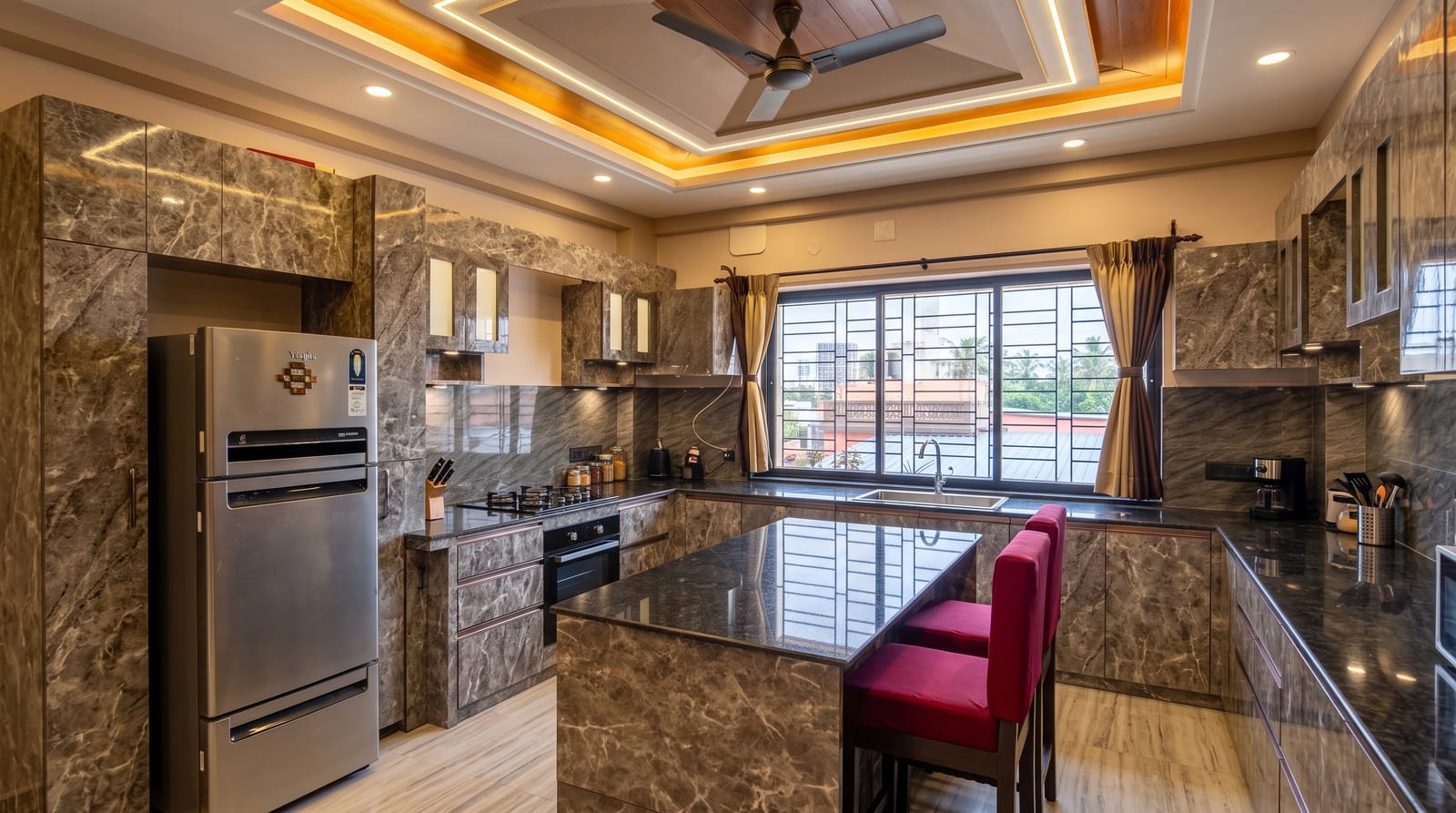
The carcass is the part of a modular kitchen you never see, and the part that decides how the kitchen ages. In Kolkata, where monsoon humidity sits in the air for months and the sink-base units take the worst of it, the choice between plywood, HDHMR, MDF and uPVC matters more than the shutter colour. This guide compares the four on cost, moisture resistance and where each one belongs in a Kolkata kitchen.
Quick answer: for most Kolkata kitchens, use BWR plywood or HDHMR for the main carcass and BWP (marine) plywood for the sink base. MDF is acceptable for dry upper units if the budget demands it, and uPVC suits kitchens where waterproofing is the top priority and the loads are modest. Indicative rates per sq ft of cabinetry run from about ₹1,200–1,800 for MDF to ₹2,200–3,200 for HDHMR. These are general market ranges, not a fixed quote.
Board choice changes the price of the whole job, so see where it sits in the overall interior design cost in Kolkata.
The four carcass materials compared
| Material | Indicative rate per sq ft | Moisture resistance | Best used for |
|---|---|---|---|
| MDF (and particle board) | ₹1,200–1,800 | Low; swells when wet | Dry wall units, tight budgets |
| BWR plywood | ₹1,800–2,800 | Good | Most base and tall units |
| BWP (marine) plywood | ₹1,800–2,800 and above | Highest | Sink base and any wet zone |
| HDHMR | ₹2,200–3,200 | High | Flat, clean-finish shutters and carcass |
| uPVC | ₹1,600–2,800 | Waterproof | Wet kitchens with modest loads |
Rates differ by brand, thickness and fabricator, so treat them as a guide to relative cost, not a price list. Marine-grade plywood made to the IS:710 standard is generally regarded as the most durable choice for areas with recurring moisture exposure.
MDF and particle board
MDF is the lowest-cost carcass and gives a smooth, flat surface that takes laminate and paint well. Its weakness is water: once moisture reaches the core, it swells and does not recover. Particle board is weaker still. In a Kolkata kitchen, keep both away from the sink base and any wall that sees condensation. If budget forces the choice, use MDF for dry upper units only.
BWR and BWP plywood
BWR (boiling water resistant) plywood handles ambient humidity well and is the sensible default for most base and tall units. BWP (boiling waterproof) plywood, made to the IS:710 marine standard, is the most durable option where water exposure is recurring. It costs more, so many good kitchens use BWP for the sink base only and BWR elsewhere. Plywood also holds screws and hinges well over years of daily use.
HDHMR
HDHMR (high-density, high-moisture-resistant board) has become a popular alternative. It is flatter than plywood, holds screws better than MDF, and is far more humidity-tolerant than particle board. It suits kitchens with flat, clean-lined shutters. Plywood remains the benchmark for the wettest zones, so treat HDHMR as a strong middle option rather than a replacement for BWP at the sink.
uPVC
uPVC cabinets are waterproof and resistant to termites, which makes them attractive in damp kitchens. The trade-offs are limited finish options and lower rigidity under heavy loads, and they are less suited to the area right next to the hob, where heat can be an issue. Rates run about ₹1,600–2,800 per sq ft. Ask to see the board thickness and a sample of the joinery before committing, because quality varies widely between manufacturers.
Where to use what inside one kitchen
| Zone | Sensible choice | Why |
|---|---|---|
| Sink base | BWP plywood | Highest water exposure in the kitchen |
| Hob base and tall units | BWR plywood or HDHMR | Needs strength and tolerance of heat and steam |
| Other base units | BWR plywood or HDHMR | Daily load and humidity |
| Wall units | HDHMR, BWR plywood or MDF | Lower moisture risk, so budget options work |
Mixing materials by zone is common and sensible. It puts the money where moisture actually does damage instead of paying premium rates for the whole kitchen.
Edge banding and hardware matter as much as the board
Moisture usually enters a carcass through a cut edge or a screw hole, not through the face of the board. Well-sealed edge banding on every exposed edge, and sealed cut-outs for pipes, do as much for longevity as the board grade. Good hardware keeps hinges tight in the board over years of use. A premium board with poor edge sealing will still swell at the sink.
How to check what you are actually getting
- Ask for the brand, grade and thickness of the carcass board in writing, separately for base and wall units.
- Ask which board is used for the sink base specifically.
- Ask to see a cut sample showing the core and the edge sealing.
- Confirm the edge-banding is applied to every exposed edge.
- Get the warranty terms in writing, including what moisture damage is covered.
What to choose at each budget
- Tight budget: BWR plywood in the base units, MDF in dry wall units, laminate shutters. Do not economise at the sink.
- Mid-range: BWR plywood or HDHMR throughout, BWP at the sink, soft-close hardware.
- Premium: BWP or HDHMR throughout with sealed edges and branded hardware, so the carcass outlasts any change of shutter finish.
Kolkata-specific points
- Monsoon humidity is constant for several months, so even the wall units see moisture. Do not assume upper cabinets are safe.
- Older buildings can have damp walls behind the kitchen. Fix the dampness first, or the best board will still suffer.
- Ventilation reduces condensation inside cabinets. A working chimney protects the carcass as well as the air.
How Choukaath specifies a kitchen
Our itemised estimate names the board for each part of the kitchen, so you can see exactly what goes in the sink base and what goes in the wall units, with fixed rates per line item. You approve the scope before any work begins, and any later additions are quoted separately. Kitchens are planned alongside the rest of the home as part of our interior design service. You can get a free consultation and fixed quote for your kitchen.
Frequently asked questions
Is HDHMR better than plywood for a modular kitchen?
Not across the board. HDHMR is flatter than plywood, holds screws better than MDF and tolerates humidity well. Good plywood, and BWP in particular, remains the benchmark for the wettest zones, so many kitchens use both.
What is the difference between BWR and BWP plywood?
BWR is boiling water resistant and handles humidity well. BWP is boiling waterproof, made to the IS:710 marine standard, and holds up best under recurring water exposure. BWP costs more, so it is often used only at the sink.
Is a uPVC modular kitchen good for Kolkata?
It can be, because it is waterproof and termite-resistant. The trade-offs are fewer finish options and lower rigidity under heavy loads, and quality varies a lot by manufacturer, so inspect samples first.
What is the cheapest carcass material?
MDF and particle board, at roughly ₹1,200–1,800 per sq ft. They are the least suited to wet areas, so avoid them at the sink.
Can I mix different boards in one kitchen?
Yes, and it is a sensible way to save. Put BWP at the sink, BWR or HDHMR in the other base and tall units, and a lower-cost board in the dry wall units.
Does the shutter finish affect moisture resistance?
Partly. The finish protects the face, but moisture usually gets in through unsealed edges and cut-outs. Edge sealing matters as much as the finish. See our laminate vs acrylic vs PU comparison.
Ready to get a quote? See our modular kitchen in Kolkata page.
